by Gayle Highpine
Cats are the number one human cause of bird deaths — more than all other causes (window strikes, vehicle strikes, pesticides, power lines, etc) put together . Cats are a major factor in the decline of North American songbird populations. If not for coyotes, the impact of this invasive species would be even worse.
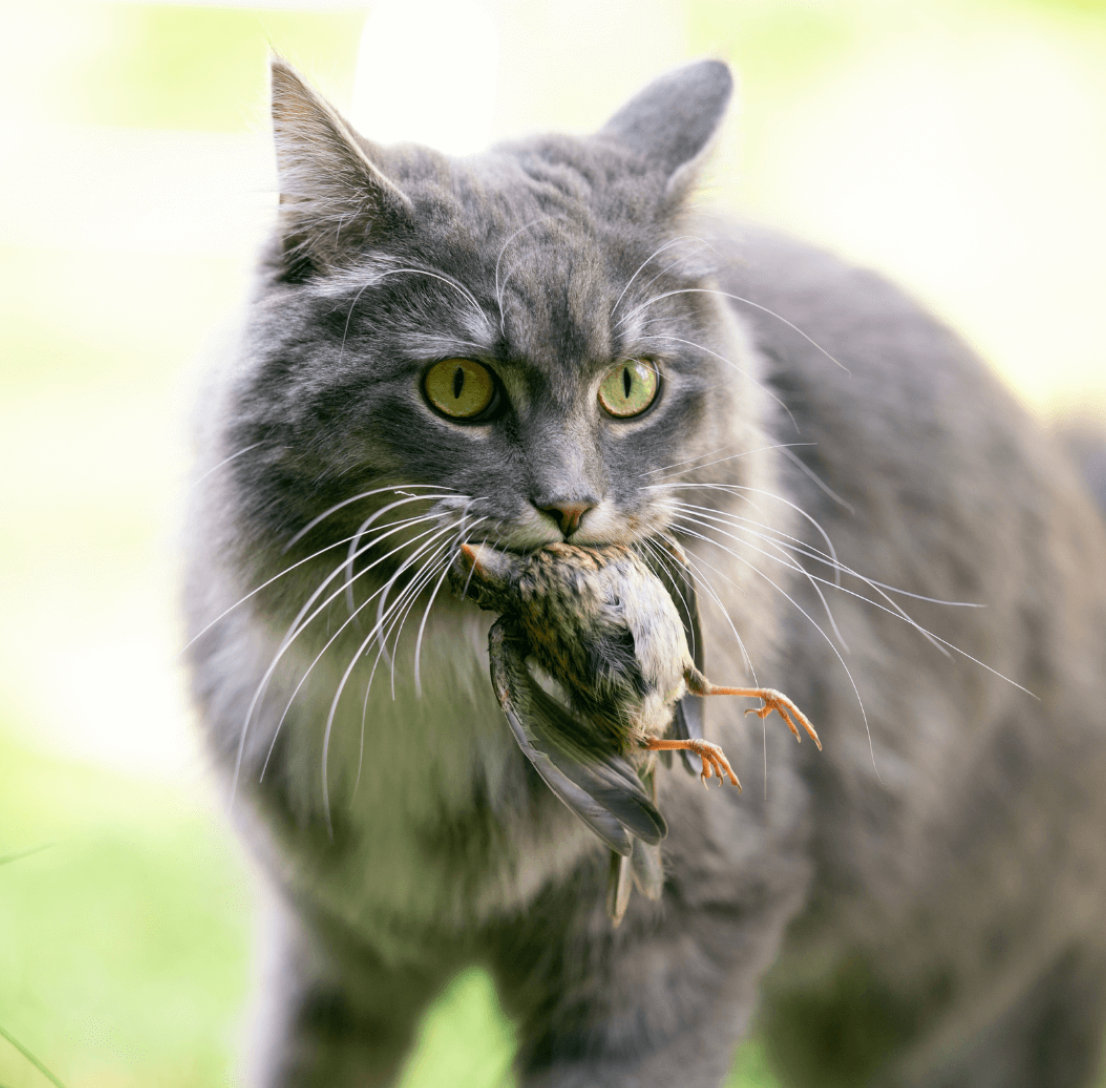
(Photo credit: Kohab NZ)
“Cats have been killing birds since forever. It’s what they do. It’s just nature. It’s the circle of life. It’s the food chain. So there.”
Such phrases are tossed off by cat owners to shrug off letting their cats roam and kill birds for sport.
Most of these excuses are meaningless. But the claim that “cats have been killing birds since forever” is simply wrong. Everywhere but Egypt, where their ancestors came from, domestic cats are an invasive species. An “invasive” species is an introduced species (animal or plant) that is harmful to native species. And domestic cats are one of the world’s most destructive invasive species. Throughout the world, wherever humans have brought them, cats have caused disastrous damage to native species that never had to deal with them before. Cats prey on thousands of species of birds, mammals, and reptiles, many threatened or endangered.
Worldwide, cats have contributed to the total extinction of at least 63 species and the impoverishment of ecosystems everywhere. And in North America, domestic cats are a recent introduction. Brought in the last couple of centuries, and still a recent intrusion in many places.
There is a grain of truth, though, in the claim that cats are part of the food chain, because cats are an important food source for coyotes. In fact, for urban and suburban coyotes, cats may be the single biggest element of their diet after rats. However, cats aren’t necessary for coyotes to survive. Coyotes have managed for thousands of years without cats to eat.
“Birds die from other things besides cats. How about all the birds who die from colliding with skyscraper windows?”
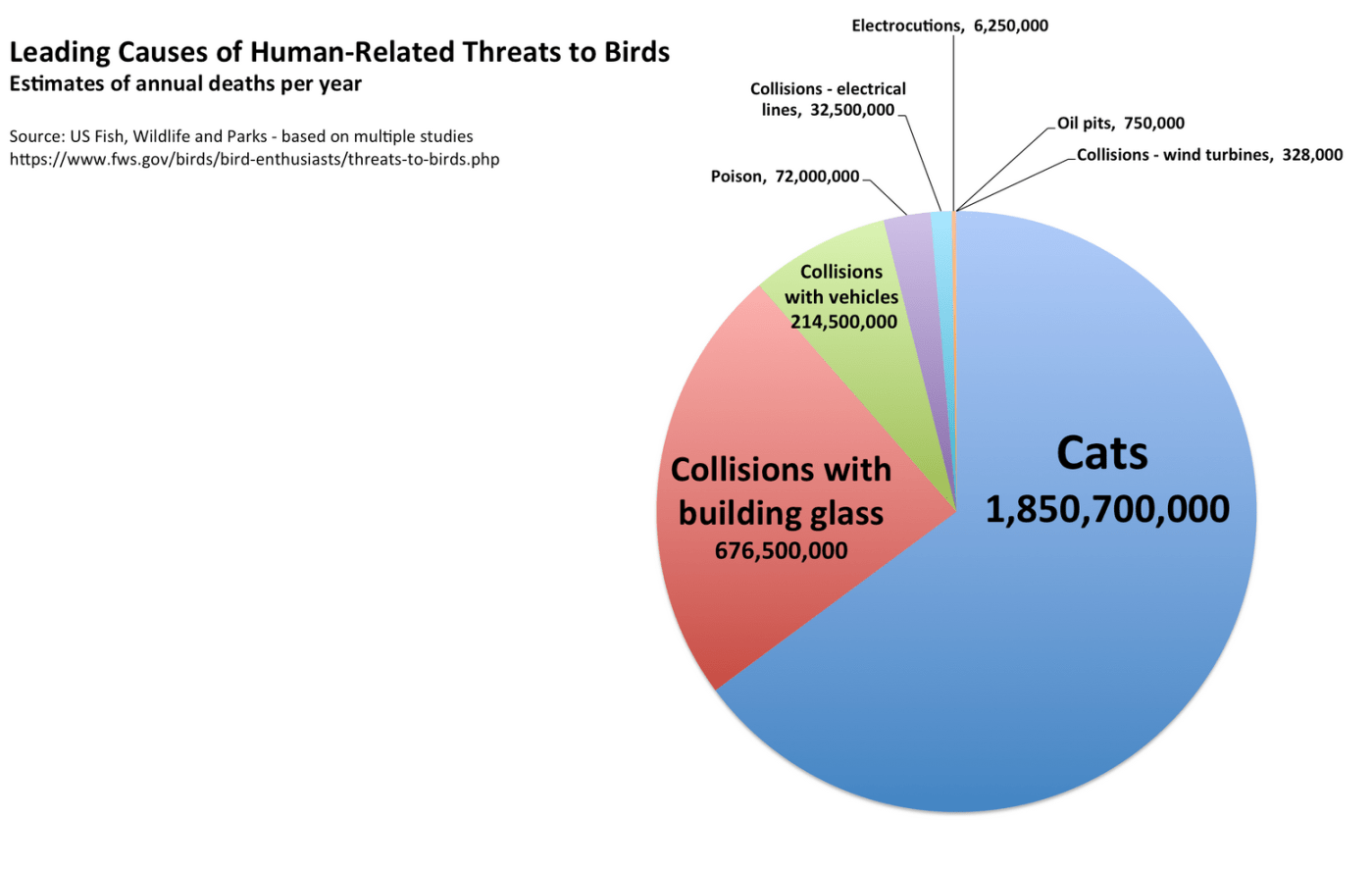
Of course all human causes of bird deaths matter. Each year, skyscraper window strikes kill almost 600 million birds. Vehicle collisions kill almost 200 million birds. Millions more birds are killed by power lines, pollution, pesticides and other poisoning. Tens of thousands are killed by residential window strikes and wind turbines.
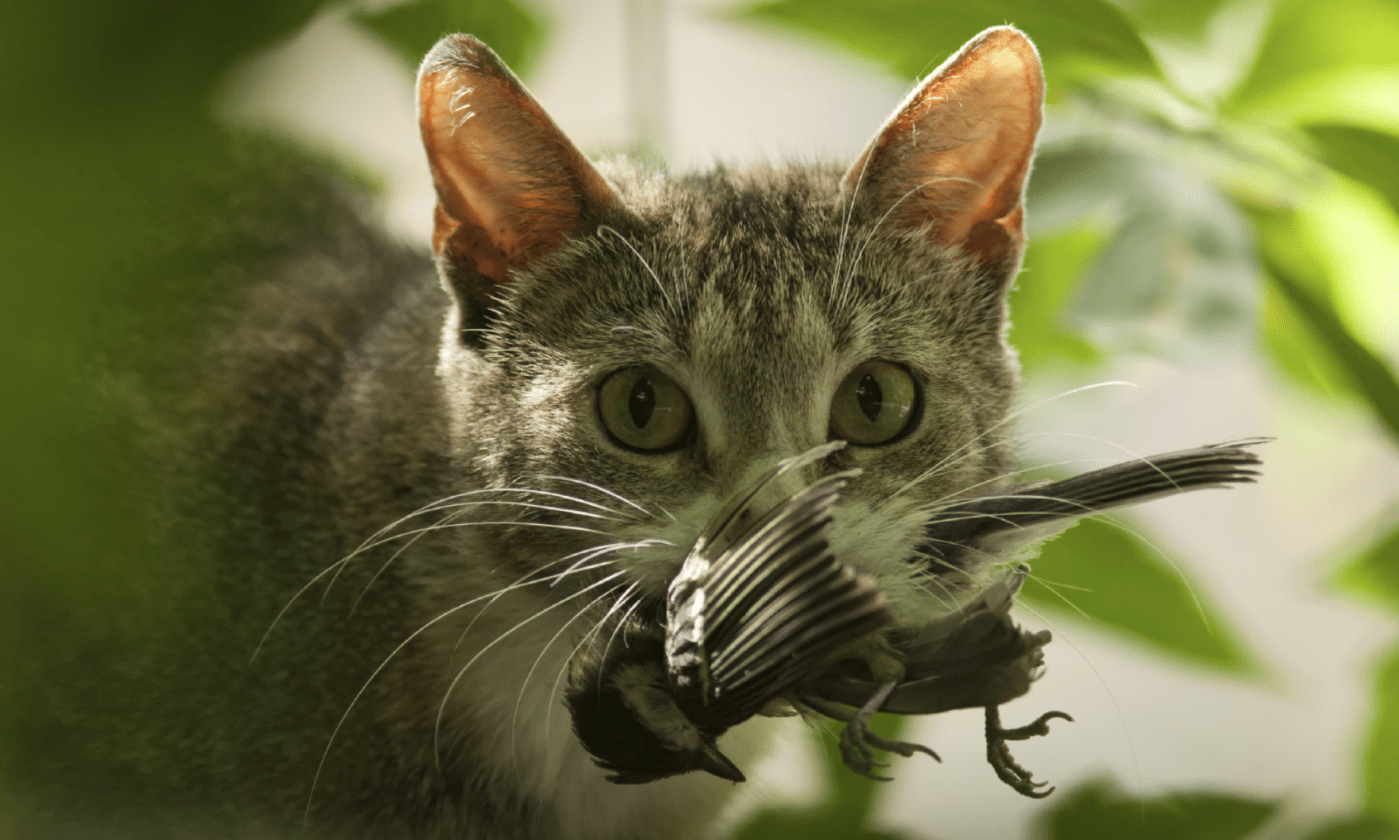
But estimates of the number of birds killed by cats in the US alone range from a low of 1.3 billion to a high of four billion. Cats are the number one human cause of wild bird deaths. In fact, even at the lowest estimate, cats cause more wild bird deaths than all other human causes put together.
(Photo credit: Vivita Shutterstock)
“If cats really kill that many birds, why aren’t we running out of birds?”
Good question. There are about twelve billion birds in the US. The billions of birds killed by cats each year is indeed a significant fraction of that. At that rate, we would certainly run out of birds in just a few years, were it not for the fact that birds have a lot of babies every year.
But they don’t have enough to keep up. And, as we’ll talk about, cats also have an impact on birds’ ability to reproduce.
So the bird population is going down. In fact, it’s going down by a lot. In just the last fifty years, the bird population of North America has declined almost 30%, and cats have had a major role in that.
Cats are implicated in the extinctions of at least 60 species worldwide. And besides those total extinctions, outdoor cats have caused extirpations (localized extinctions) of countless bird species.
A study of urban cat predation in the city of Dunedin, New Zealand, estimated the total catch for six bird species at close to the total population of those birds in the city, and said that statistical modelling “indicated low likelihood of population persistence with cat predation.” In other words, those bird species appear headed to be for extinction in that city, as a direct result of cats.
Researchers in California compared a state park with 25 cats to a state park with no cats. They found that the park with cats had only half as many birds as the park with no cats, and that in the park with cats, some species, like the California Quail and California Thrasher, were completely wiped out.
The one US state with no coyotes to keep the cat population in check – Hawaii – holds the title of Bird Extinction Capital of the World. Cats, of course, are not the only cause of the extinctions. Habitat loss and introduced diseases (some spread by the cats) also contribute. But even in habitats that appear to be intact, even in pristine-looking Hawaiian rainforest, cats prowl by the thousands, busy wiping out the last of Hawaii’s remaining native birds.
Just one cat can do a lot. In Australia, just one single cat wiped out an entire breeding colony of Fairy Terns. In New Zealand, just one single cat (a pet named Tibbles) drove an entire species, the Stephen’s Island Wren, to complete extinction.
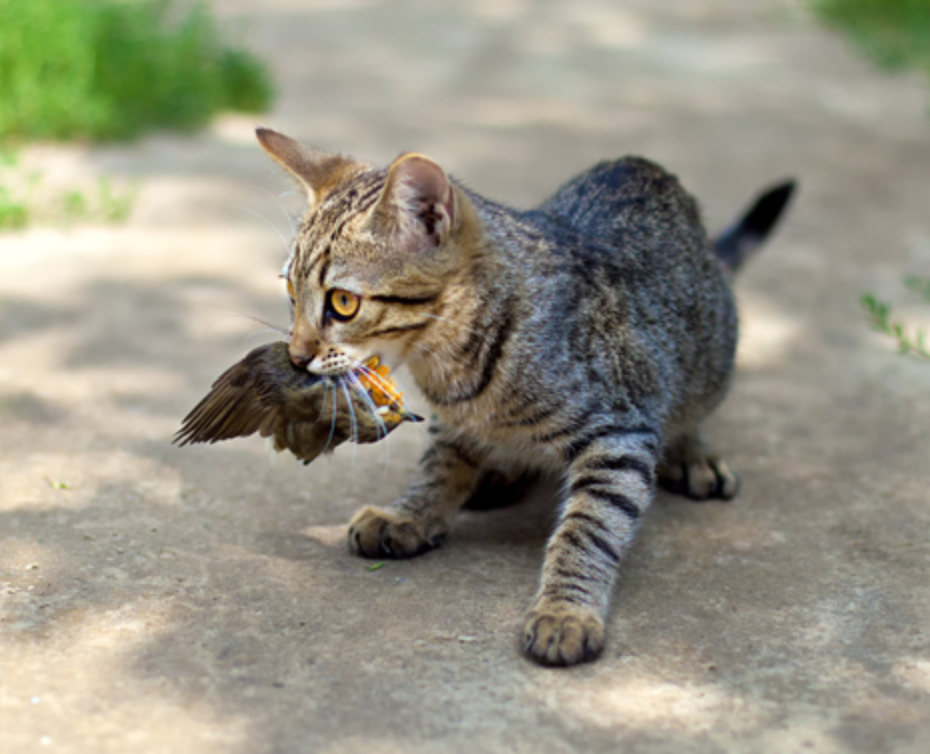
“My cat doesn’t catch very many birds.”
And how do you know how many birds your cat kills? Do you count the birds your cat brings back to you? Do you keep track of the times you see your cat playing with a dead bird? Do you keep track of the bird remains in your yard? Or look for bird remains around the neighborhood where your cat roams?
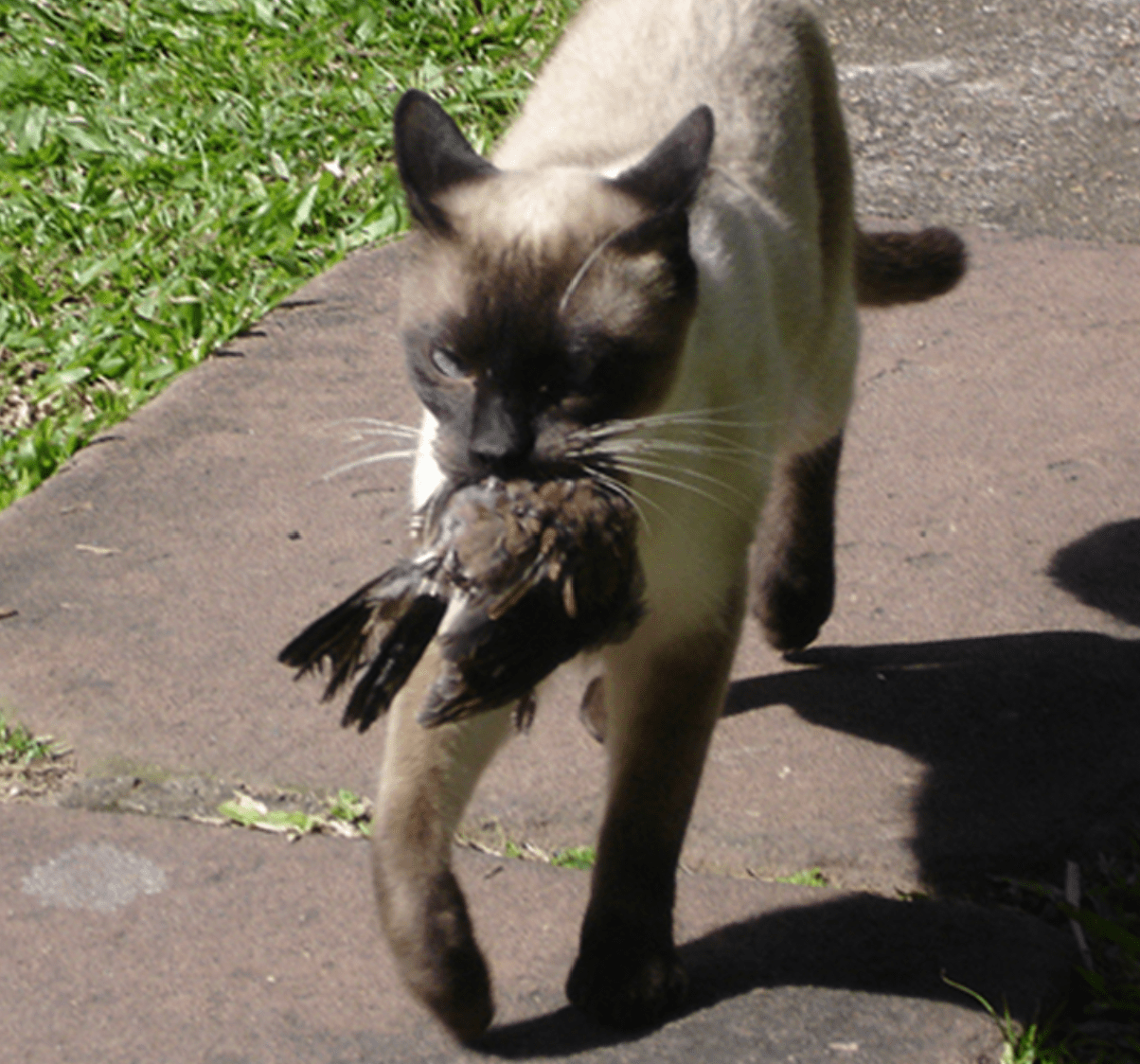
And how many birds is “not very many”? In one study, on average each cat brought home fifteen birds. Another study said 13.4 birds. A bird a month or so? To some owners, that “not very many.” But fifteen birds a year times 32 million outdoor pet cats in the US comes to almost half a billion birds a year. Killed by well-fed cats, purely for sport.
(Feral cats, who live by hunting, kill about four times as many birds each as pet cats. However, according to an Australian study, the much higher population density of urban pet cats means that their kill rate locally is 28 to 52 times that of feral cats in natural environments and 1.3 to 2.3 times greater than that of feral cats living in urban areas).
But cats don’t bring home all the birds they kill. Sometimes a cat loses interest in its prey and drops it. Sometimes a cat actually eats its victim rather than bringing it home. Sometimes a cat fails to catch the bird, but, if it was scratched, that bird will die in a few days.
On average, a cat brings home less than a quarter of its prey. That means that a cat who brings home fifteen birds a year may really be killing over sixty birds a year. A study of outdoor cats, using trail cams, found that the toll of the average cat (including outdoor pets, strays, and ferals) was actually 48 to 60 birds a year. That averages to about one bird per week, although the catch is not spread evenly throughout the year – most catches are made during fledgling season.
Yet, some cat owners who think their cats are not killing many birds may be correct. A study was made in the UK of cats whose owners said their cats didn’t kill many birds. The study concluded that the cat owners were probably right. But that “low predation rates in urban areas do not necessarily equate with a correspondingly low impact of cats on birds…. [L]ow predation rates simply reflect low prey numbers.” In other words, the reason that the cats weren’t killing many birds because there weren’t many left around for them to kill.
“When my cat brings me a bird, usually it is still alive. I let it go and it flies off and it’s fine.“
The bird will still die, even if it takes a couple of days. Your cat has still killed it.
Cats have deadly bacteria in their teeth and claws that will infect and kill a bird with the slightest break in the bird’s skin. This undoubtedly helps them to catch prey in the wild; usually, when the cat pounces on its prey, it is not able to grab the prey securely and the prey gets away with only a scratch. But the prey will soon die from the scratch and the cat will find it later.
“What about other animals who prey on birds? Like foxes and raccoon and … how about hawks? They are birds themselves! Why aren’t you mad at hawks? Why pick on cats?”
Native predators live in balance with their prey populations. In simplified form, the predator/prey cycle works like this:
The rabbit population goes up. With more rabbits to eat, so the fox population goes up. With more foxes eating them, the rabbit population goes down. Now there are fewer rabbits to eat, so the fox population goes down. Now there are fewer foxes eating them, so the rabbit population goes back up. Now there are more rabbits to eat, so the fox population goes back up. And so on.
But if the fox population were to stay high even when the rabbit population went down, the rabbits could eventually be wiped out.
That is like the situation with domestic cats. No matter how much the prey populations decrease, the cat population doesn’t. The cat population is kept artificially high by humans. Not only outdoor pet cats, but stray cats fed by humans.
Let’s compare the impact on songbirds of cats with the impact of the two main natural predators of songbirds, the Cooper’s Hawk and the Sharp-shinned Hawk.
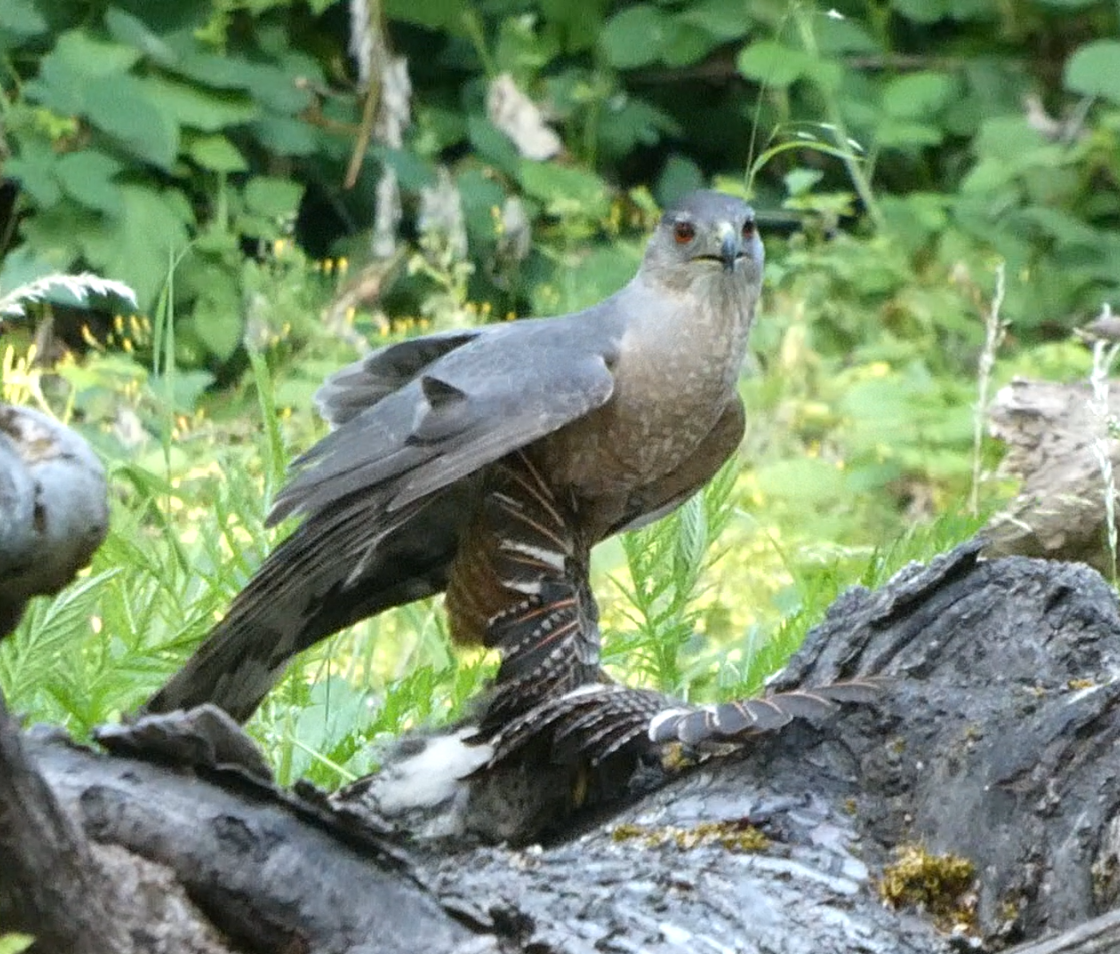
A Cooper’s Hawk with a Flicker it has caught
(Photo by author)
The territory of a Cooper’s Hawk pair be around a square mile. Having a territory ensures that a bird family will have enough food to raise their young. Birds don’t care if birds of other species come into their territories, but other birds of their own species have to keep out, because birds of the same species compete for the same foods. The Sharp-shinned Hawk territory can overlap the Cooper’s Hawk territory because the two don’t compete for food; being of different sizes, they hunt different prey – the larger Coopers hunt birds the size of robins, and the smaller Sharpies hunts birds the size of chickadees.
Within this same square mile are thousands of songbird territories. Depending on how much food there is for each, some birds, like the Song Sparrows, may have territories as small as a half-acre or less, so a thousand Song Sparrow families may live within that square mile. Songbirds who need more land to feed their families have larger territories. Each species has its own set of property lines, which overlap the property lines of other species. Altogether, this square mile may be home to several tens of thousands of songbirds, doves and woodpeckers.
If it could, a Cooper’s Hawk would catch a bird a day to feed itself, though it is rarely that lucky. But when they are raising babies, the hawks have to catch food for the babies as well. Each baby will need at least 60 birds to eat between the time it hatches and the time it is weaned. Four babies comes to 240 prey birds. Add the birds that the parents themselves eat. Altogether, over five hundred birds a year may die to support just one Cooper’s Hawk family.
The average outdoor cat, on the other hand, kills only a bird a week, a lot fewer than a Cooper’s Hawk. So why are we concerned about cats and not hawks?
This particular square mile is in a human suburb and contains a thousand human dwellings. Half of those households have a free-roaming pet cat. So the square mile is prowled by five hundred pet cats. And that’s not even counting the feral cats.
If each cat kills just one bird per week, five hundred cats kill five hundred birds per week. More than the entire family of Cooper’s Hawks consumes in an entire year. Five hundred birds per week comes to 26,000 birds per year. A substantial impact on the local bird population.
The Cooper’s Hawks hunt all over their square mile, grabbing a robin here, a Mourning Dove there. a Downy Woodpecker over there. They can’t just find one spot with lots of birds and stick to that spot. As stealth hunters who hunt from ambush, they can catch a bird only if the bird doesn’t know the hawk is there. As soon as the hawk’s presence is revealed, the songbirds go hide. And if the hawk were to keep returning to the same spot, the songbirds would leave that spot for good.
So the Cooper’s Hawks need a very large territory to support themselves. That keeps them from over-hunting their territory and depleting the songbird population. In nature, predators have to have much larger territories than the prey animals, which limits the predator population to what the prey can support. It is nature’s perfect system for keeping predator and prey in balance.
Cats, on the other hand, stick close to home and concentrate their impact on one spot. And their population can grow without limits and become very dense, due to human support. And the birds can’t escape to a safer place when they become aware that a cat is hunting one spot, because their whole square mile is saturated with cats. Even the yards of human families who don’t have cats are not safe, because the neighbors’ cats come over to hunt. There is no safe place for the birds.2
(Photo credit: Vishnevskiy Vasiliyi Stockphoto)
“The birds have plenty of babies to replace the ones killed by cats.”
Cats don’t just kill birds, They affect the ability of birds to reproduce.
First of all, cats massacre fledglings – baby birds who have newly left the nest. For the first few days or weeks, fledglings can’t fly, and they know nothing about danger. Even for the most incompetent and unskilled feline hunter, fledglings are a piece of cake.
Researchers who conducted a study on Gray Catbirds in Maryland, as a representative of suburban songbirds, found that almost 40% of their fledglings were killed by cats. They surmised that, although the catbirds know how to look for nesting areas that are safe from crows and hawks and foxes and weasels, predators they have known since forever, they didn’t have enough experience with cats to recognize cat danger. A suburban yard full of trees and bushes looks like a perfect nesting area. The songbirds don’t realize that the humans have created a death trap for them.
And even if a cat doesn’t kill any birds. Its very presence can lessen their ability to reproduce. Let’s say a pair of Wood Thrushes has made a nest in a tree and hatches a brood of babies. One day, a cat climbs the tree. He’s not after the nest; he doesn’t even know it is there. But while the cat is up there, the parents will not feed the babies, because they don’t want to give away the location of the nest to a predator. If a cat lounges in the tree for hours, that can mean hours of starvation to the babies, weakening them severely.
And that only has to happen once to affect how the parent birds take care of their babies. Even when the cat is on the ground, the parents cut down their trips to and from the nest, because they know the cat could climb the tree if it knew the nest was there. Even when they don’t see the cat around, it could be hiding and watching, so the parents make as few trips to the nest as possible. If the babies survive long enough to fledge, they can be too weakened to live long.
As the songbirds become aware of cats in an area, they can stop nesting there. People wonder about the birds that they used to see frequently, but have now become rare. Cat-savvy adult songbirds may sometimes travel to unoccupied areas to look for food, so, once in a while, bird lovers may be thrilled by the appearance of an old friend at the feeder. But since those birds can’t nest there anymore, their population may still be going down.
Bird population levels depend, above all else, on habitat. Preserving habitat is the best way to help save birds. (And humans too, but that’s another story.) No matter how green an area looks, if it is unlivable for birds, the birds have lost habitat.
Cats don’t cause habitat destruction, cats are habitat destruction.
Look up into the trees and see how many birds you don’t see. And we think that is normal.
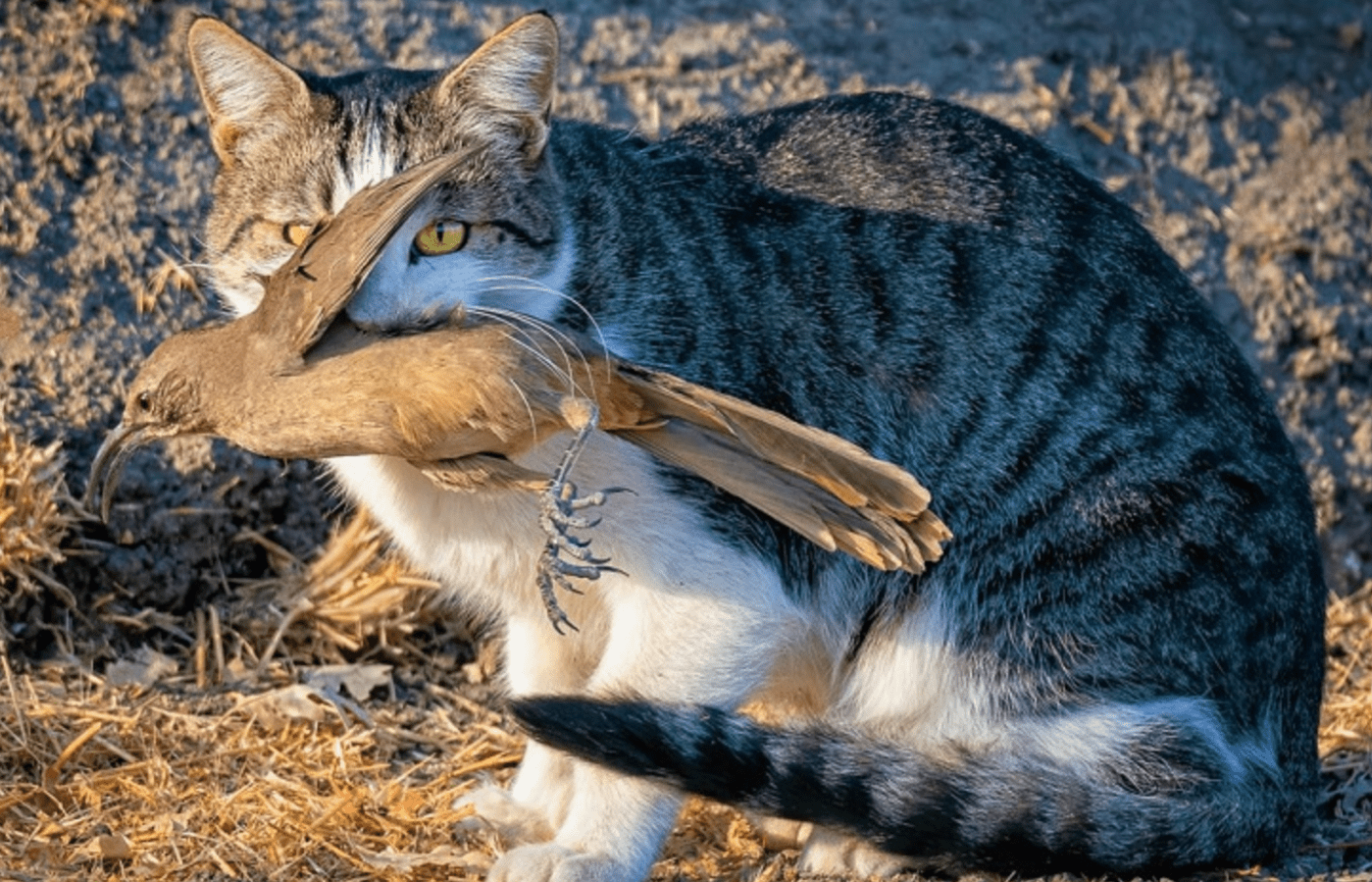
(Photo credit: World Animal Foundation)
“My cat has to be outdoors to control rats and mice.”
If a house is infested with house mice, then letting the cat roam outside won’t do anything to fix that. Obviously, to deal with mice in the house, the cat must be in the house. House mice rarely venture outdoors. Norway rats live both indoors and outdoors, but the average pet cat doesn’t have the hunting skills for a prey that smart. Coyotes are the main controllers of rats.
The prey of outdoor cats is mostly native wildlife. Not only birds, but small mammals like chipmunks and voles, and bats, reptiles like lizards and garter snakes, amphibians like tree frogs and salamanders, and winged insects like butterflies and dragonflies – pretty much any living thing that moves and that is small enough for them to catch. True, many of these creatures are not endangered, but they can be wiped out of the local ecosystem. I saw the cats exterminate the entire Townsend’s Chipmunk population where I live, and I was powerless to stop it.
And, by hunting small animals like native rodents, cats deplete the prey animals that native wild predators, such as foxes, skunks, raccoons, opossums, weasels, coyotes, bobcats, hawks, and owls, rely on to survive. (And, through their poop, domestic cats can spread fatal feline diseases to native wild cats such as bobcats, lynx, mountain lions,and endangered Florida panthers, who have no resistance to those diseases.)
Barn cats are the only cats with a legitimate reason to be outdoors. A cat who lives in a barn teeming with rats and mice, and who has to survive by hunting them, because it is not fed by humans, will usually have little impact on local bird and wildlife populations. A cat who survives by hunting does not waste precious energy on hunting for sport. And birds are much harder to catch than rodents, and mother cats may not even teach their youngsters the skills of bird-hunting.
And a barn cat stays in one place. The birds know where that cat lives and stay away from that place. And barns are few and far between. So barn cats are easy for birds to avoid.
But a suburban home does not need an outdoor cat for rodent control. In fact, letting cats roam outdoors can make a rat problem worse. Coyotes are our main rat control. But a cat has over ten times the meat of a rat and a cat is much easier for a coyote to catch than a rat. If there are a lot of cats wandering outside for the coyotes to eat, they will catch fewer rats, and if the coyotes are not catching them, the rats can multiply.
“If the neighbor’s cats come to your yard to kill your feeder birds, that’s your fault. You attracted the birds to your yard with your feeders, and you attracted the cat by attracting the birds.”
Sometimes people who feed birds wonder if it really is their fault when neighbor cats come over and kill birds. (Bird lovers can be too tender-hearted sometimes.) But this charge is absurd..
Look around at your yard. Is it good bird habitat? Rich with food and nesting spots and clean water and other resources for birds? Then you will have birds in your yard, whether you feed them or not.
If you stop feeding the birds, but your yard has good bird habitat, you will still have lots of birds, you just won’t be able to see them as much. The birds would be in your yard anyway, and that cat would be coming over anyway.
By the logic above, you should solve the cat problem by make your yard a habitat desert that is worthless for birds. With no birds, there would be no cat coming to hunt them. That’s like protecting your house from burglars by burning it down.
“The cat is bored indoors. I want my cat to have fun.”
It is possible to create an enriched, fun environment for an indoor cat. Many cat owners build beautiful catios for them.
(Photo credit: Stockxchng)
“My cat refuses to stay indoors. It always escapes.”
Well, it’s not all or nothing, There are ways to reduce the carnage of an outdoor cat. In fact, a combination of methods can potentially reduce a cat’s toll by 90% or more.
But the typical cat owner simply doesn’t care.
I used to think that people who loved an animal probably cared about animals generally, and about nature. But social media has consistently shown me that this is not the case. Owners of outdoor cats don’t care about other animals, nor about protecting nature.
Even cat owners who do decide to keep the cat indoors almost always do it only for the safety of the cat. Almost never does a cat owner cite the protection of birds or other wildlife as a reason to keep cats indoors. Not even as a secondary reason. Not even as a fringe benefit!
So I don’t bother sympathizing if someone’s outdoor pet cat becomes a meal for a coyote. If someone doesn’t care that their cat kills wildlife, how can they complain when their cat is killed by wildlife?
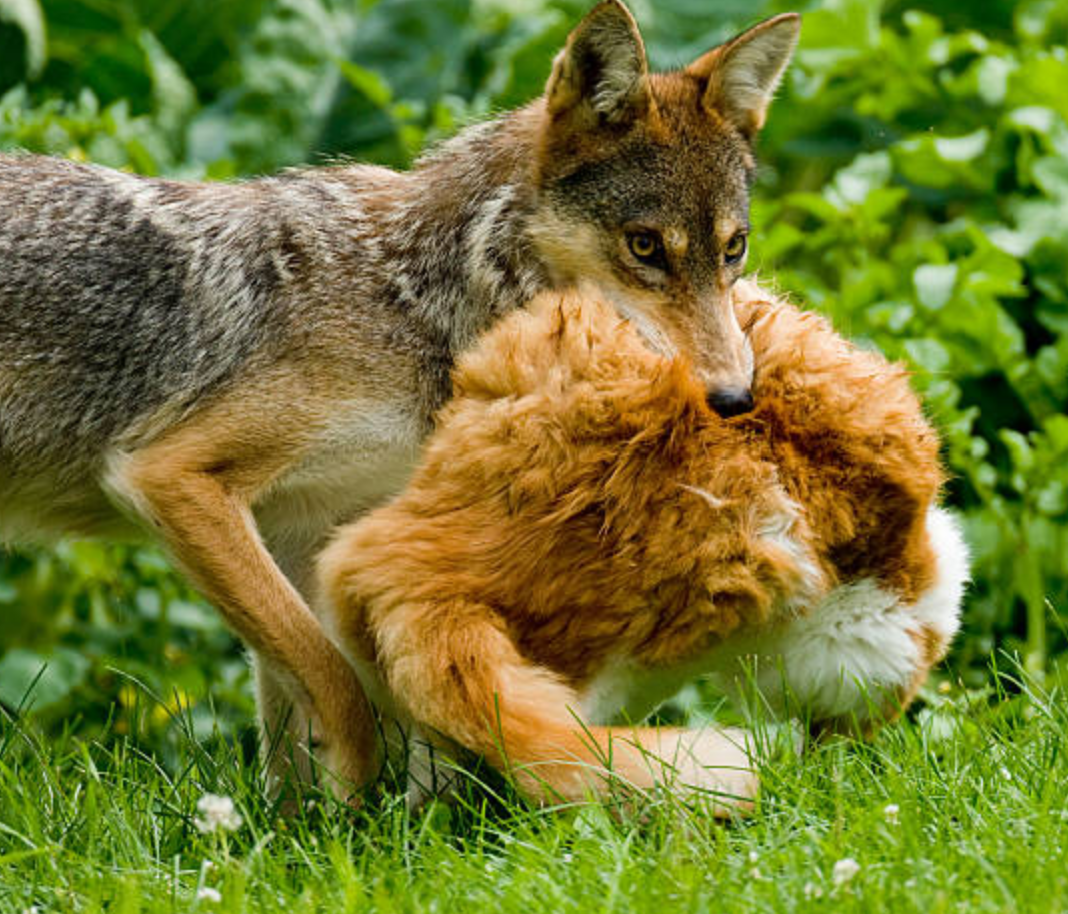
And a coyote, unlike a cat, kills smaller prey instantly, by shaking it and breaking its neck. So Kitty’s owners can take comfort that Kitty didn’t suffer. And Kitty gets eaten, so his death doesn’t go to waste.
(Photo credit: IStockphoto)
“Coyotes are a menace. They eat our poor cats. Because of the coyotes, I have to keep my cats indoors.”
Hooray for coyotes.
Every time a coyote kills an outdoor pet cat, it has probably saved ten or twenty or forty birds who would have been killed over the next year by that cat. But not just those birds. The coyote helps save countless more birds if the owner reports the death or disappearance of poor dear Fluffy on social media. The more people report the loss of their cats to coyotes, the more other cat owners are inspired to keep their cats indoors.
(Unfortunately, coyotes can also pose a threat to small dogs, so, for that reason, we need to haze coyotes and keep them afraid of humans. Causing the coyotes to fear humans helps to protect dogs from them, because dogs, unlike cats, are almost always either near their humans or in their humans’ yard. Dogs don’t wander around through neighborhoods and parks and woods and fields.)
We are fortunate in North America to have coyotes. Coyotes are an important part of the ecosystem. Coyotes are our main rat control. More important, coyotes are our main cat control. They help keep feral cat populations in check, and they cause many cat owners to keep their cats indoors.
Thank you, coyotes, for helping to protect the birds!
Gayle Highpine is the author of How To Make Friends With Wild Birds (Kinnikinnick Press).
1 Well, not really. Chickens are birds.
/

 birdfriender.net
Leave a comment