by Gayle Highpine
Coyotes have lived in every part of Oregon since time immemorial. How did the idea come about that coyotes are not native to Oregon?

Throughout the state of Oregon, billboards display the logo of Spirit Mountain Casino, which is run by the Confederated Tribes of Grande Ronde.
Over thirty tribes and bands are represented at Grande Ronde. They include names familiar to Oregonians, like Tualatin (Atfalati), Yamhill, Santiam, Multnomah, Clackamas, Cathlamet, Tillamook; Molalla, Umpqua; Yoncalla; and Shasta – nearly all from west of the Cascades. They include the tribes from the greater Portland area – the Kalapuyas, who lived in what is now the Portland area and throughout the Willamette Valley, and the Chinook, who lived along the lower Columbia River and lower Willamette.
With so many different cultures represented, what symbol could the Confederated Tribes of Grande Ronde use that would be meaningful for all of them? That was easy – Coyote.
Coyote is of central significance in Indigenous cultures of the Pacific Northwest, as he is through most of the North American West. Anthropologists in the early twentieth century collected hundreds of Coyote stories from elders who knew little or no English but carried the traditions of their peoples.
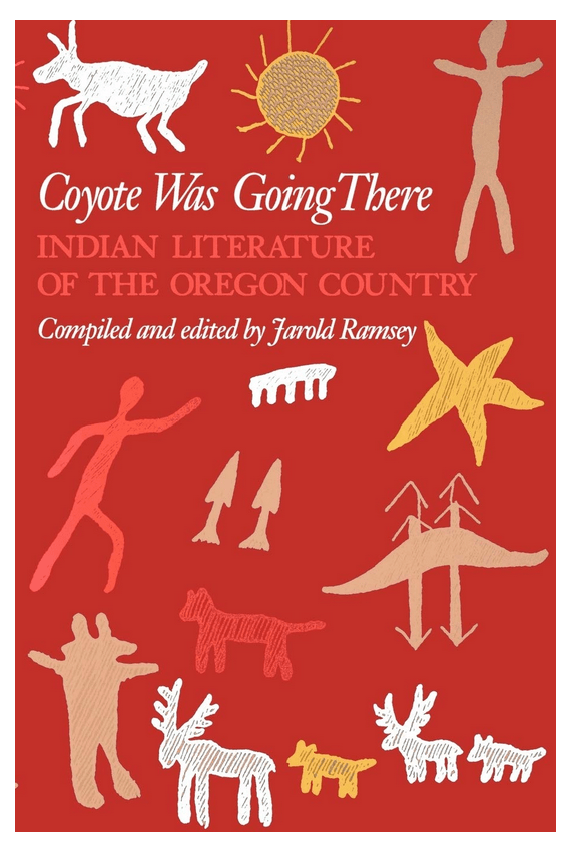
The very title of the book Coyote Was Going There: Indian Literature of the Oregon Country testifies to the importance of Coyote in Native cultures throughout Oregon, because so many stories begin with “Coyote was going there” or “Coyote was going along.”
In the introduction to Coyote Was Going There, the editor, poet Jarold Ramsey, who grew up near Warm Springs Reservation, writes:
“The figure of Coyote is prominent in Native American traditional narratives in Oregon and throughout the West…. In many Coyote stories—notably, those set in the Myth Age, when reality is being constructed—he is a transformer as well as a trickster. …. It is a measure of the importance (and perhaps the seductiveness) of Coyote stories in Native cultures in Oregon and elsewhere that by custom they were not to be told casually between spring and early fall, when there was work to be done outdoors. Instead, they were sanctioned for formal indoor performance, in winter, in the season of spirit-power celebrations. ….Coyote stories are still popular in Oregon’s Indian communities today.”
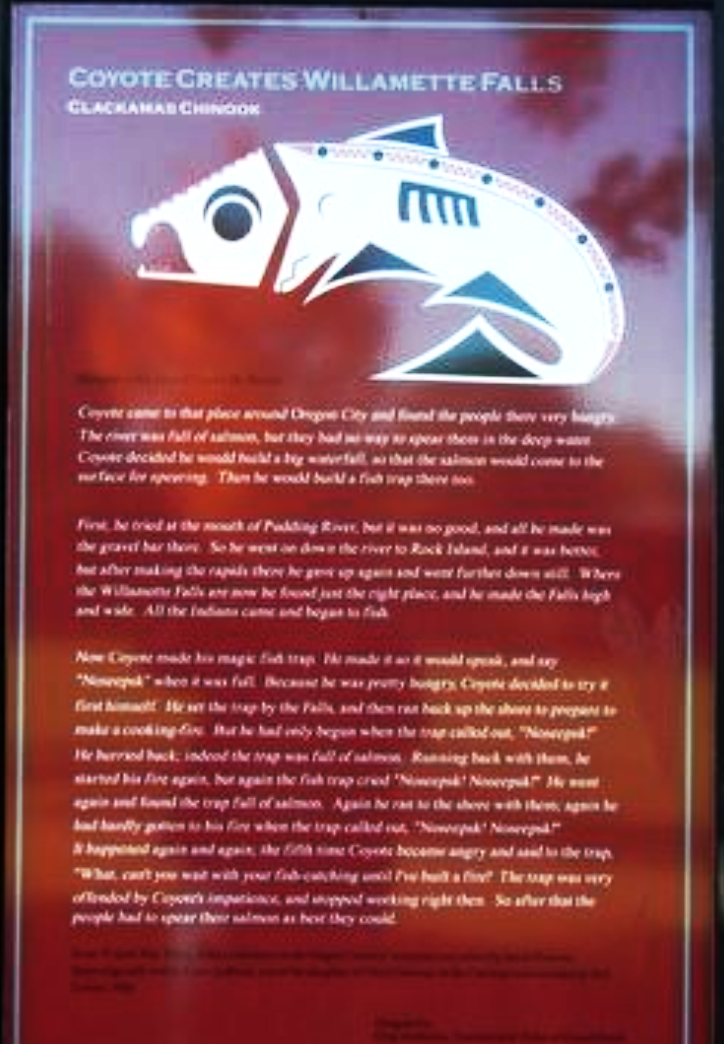
Indigenous peoples testify that Coyote is ancient to the land. Coyote helped to shape the landscape to help humans to live on it. According to a legend of the Clackamas Chinook. Coyote created Willamette Falls near present-day Oregon City. According to a Wasco legend, Coyote created Multnomah Falls. According to a Nimipu legend, Coyote created Celilo Falls.
The Clackamas Chinook story of how Coyote created Willamette Falls (recorded by non-Indigenous people in 1900) mentions other local landscape features as well:
“First he tried at the mouth of Pudding River, but it was no good, and all he made was the gravel bar there. So he went on down the river to Rock Island, and it was better, but after making the rapids there he gave up again and went further down still. Where the Willamette Falls are now he found just the right place, and he made the Falls high and wide. All the Indians came and began to fish.”
The Confederated Tribes of Grande Ronde used these documented ancient traditions as proof to help to establish their ancestral right to fish there. Tribal member Greg Archuleta, a member of the Confederated Tribes of Grand Ronde who is descended from the Clackamas Chinook, Santiam Kalapuya, and Shasta, speaks of how Coyote shows the ancient connection of the Clackamas people to Willamette Falls:
“Our connection to Tumwater, Willamette Falls, goes back to time immemorial. Our tribes, our people tell the ancient stories, we call them the ikanam. In those ikanam, we have the different ages of Coyote. And one of those was the age of Tsk’unkiya. It was an ancient Coyote that went along the river and deemed the importance of the traditional foods to our people.”
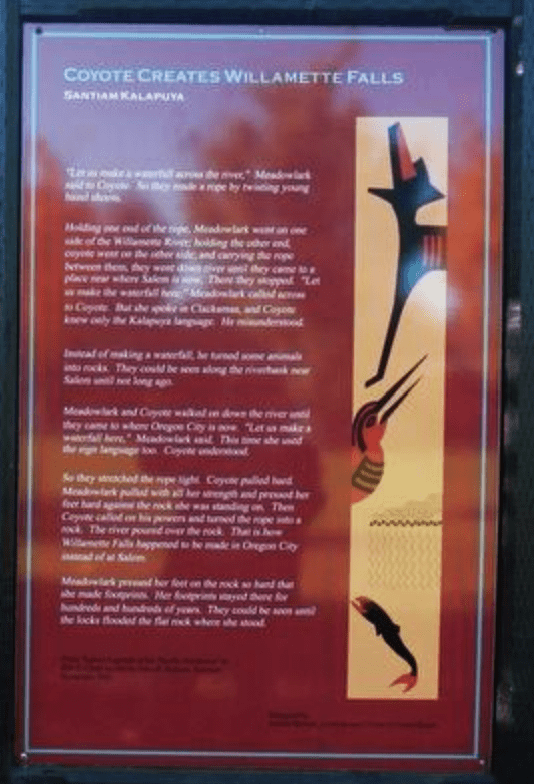
The Santiam Kalapuya, south of Willamette Falls, have their own legend about Coyote creating the Willamette Falls – in this case, in collaboration with Meadowlark. This story was published in Indian Legends of the Pacific Northwest by Ella E. Clark in 1953. Both the Clackamas and Santiam stories are recounted by historical markers near Willamette Falls.
In the legends of the Kalapuya people, Coyote created many other waterfalls, creeks, and rivers. In one story, the Frog People had dammed up all the water. On the pretext of getting a drink, “Coyote was digging out under the dam all the time he had his head under water. When he was finished, he stood up and said, ‘That was a good drink. That was just what I needed.’ Then the dam collapsed, and the water went out into the valley and made the creeks and rivers and waterfalls.”
The name of Ahsney Creek, near Corvallis, means “The Coyote” because “Coyote is a leading protagonist in the Ampinefu [Kalapuya] stories.”
On the coast, “Yelis is Coyote, the culture hero of the Coos, Alsea, and other tribes of the Oregon coast. Although Yelis behaves as a trickster character in some Coos stories, he is also a more serious transformer figure who teaches the people how to live and helps shape the world for them, and therefore he was a respected figure among the Oregon Coast tribes.” Further north on the coast, the Clatsop, near present-day Astoria, tell how Coyote created the Clatsop Plains to provide a prairie for gathering roots.
In a legend of the Takelma people of the Rogue River, Coyote tells the people, “People shall spear salmon, they will go to get food, to one another will they go to get food; one another they will feed, and they shall not kill one another. In that way shall the world be, as long as the world goes on.”
“In the Wasco Chinookan story-cycle, for example,” writes Ramsey, “Coyote travels up the Columbia River, tricking the Myth Age figures he meets, but also setting mythic precedents as he goes.”
Shaping the land was only one of Coyote’s roles. The article “Coyote: Hero, Trickster, Immortal and Respected Animal In Native American Myths” says “the Coyote remains the most common trickster figure [of the Kalapuyas]. The Kalapuya stories about this Old Man Coyote range from funny tales of mischief and clowning to legends with much more profound meaning and are devoted to the nature of the world.”
The Fort Vancouver National Historic Site says, “Coyote is an important figure in the stories and spirituality of the Indigenous people of the Lower Columbia River.”
We have hardly touched traditions from east of the Cascades – Nez Perce, Umatilla, Wasco, Tenino, Yakama, Okanagan, Coeur d’Alene, Kootenai, Salish, Kalispel, Shuswap, and so on – because the documented traditions from that region are so extensive that they would make this article far too long.
Are coyotes native to Oregon?
Coyote has lived on this land since forever — or at least longer than humans have, according to the humans who are original to this land.
Yet many (non-Indigenous) people say that coyotes are not native to Oregon. When discussions of coyote sightings come up on social media, some people claim that “science says” that coyotes didn’t live in Oregon until the twentieth century.
Science actually says no such thing. There is in fact zero scientific evidence that coyotes are not native to Oregon. This notion is based purely on folkloric beliefs that developed among white settlers who came here.
So how did the newcomers to Oregon get this idea?
Well, white settlers first encountered coyotes on the prairies. Especially after they brought sheep to the prairies. Then they discovered lots of coyotes.
When they wiped out the buffalo (which coyotes cannot hunt) and introduced sheep, the coyotes’ food supply suddenly increased greatly, and so did the coyote population. The more sheep, the more coyotes there were to eat them.
So a campaign began to exterminate the “prairie wolves.” Starting around 1850, and continuing to this day, sheep farmers, or wildlife services operating on their behalf, have tried to wipe out coyotes by every possible means. Coyotes are shot on sight, they are poisoned with 1080 and with cyanide bombs, they are caught in neck snares, leg traps, and other traps, they are gunned down from planes and helicopters, their dens are dynamited, they are tracked with hounds, they are run down with snowmobiles.
But the coyotes quickly catch on to different kinds of traps and poisons. Once one coyote has been caught in a particular kind of trap, or fallen for a booby trap such as cyanide bombs or sheep collars containing liquid poison, others in the pack quickly become wise, and that kind of trap is no longer effective. Coyotes continue to be slaughtered at taxpayer expense — an estimated half a million coyotes per year, or one per minute. Yet, after over 170 years of extermination efforts, coyotes have steadily increased their numbers and spread their range.
Coyotes, like most predators, are territorial. A territorial system, which usually allows only one breeding pair per territory, keeps the predator from overpopulating and overhunting the available prey. If one or both members of a breeding pair of coyotes are killed, then pack members who weren’t breeding before will pair up and start reproducing. And if a whole pack is killed, coyotes who didn’t have territories before will move in. The number of breeding animals remains constant.
This is similar to the way territorial songbirds regulate their populations: only a pair with a territory can breed, and the territorial system ensures that each family will have enough food. But more babies are born than there will be available territories for, as insurance for the species; if the breeding pair who holds a particular territory is killed, that territory becomes available for birds who didn’t have one before, so the territory is refilled, and the breeding population of that species stays in balance with what the area can support.
But this territorial system doesn’t protect animals from intentional extermination. Humans have successfully exterminated other predators, such as wolves and cougars. Coyotes, however, have experience with the problem of dealing with larger, stronger predators determined to wipe them out.
Coyote packs, like wolf packs, usually have only one breeding pair. If non-breeding individuals are wiped out, it doesn’t have much effect on the population. If the breeding pair is killed, other members of the pack will take their places as breeders. So the population still stays stable. But coyotes have looser pack structures than wolves, and, besides the resident pack, lone coyotes wander from territory to territory. If the whole pack were to be wiped out, the lone coyotes will find mates, claim the territory for themselves and start breeding.
But wolves do that as well, and it didn’t stop wolves from being exterminated. Coyotes have another trick up their sleeves that other predators don’t have. If large numbers of coyotes are killed, so that their population drops below the available food supply, the coyotes actually increase their reproductive rate. They have larger litters, and females start breeding at younger ages. This is called compensatory reproduction. So within a few generations, the coyotes recover their population, and their numbers come back into balance with the available food.
This ability to have larger and more frequent litters when the population drops is almost unique in the animal kingdom. The only thing that can cause an animal to evolve this ability is if it is persecuted by another creature determined to wipe it out. Prey species don’t need this ability, because a predator doesn’t try to wipe out its prey. Predators want their prey species to survive, so they will continue to have food. If a pack of wolves kills one caribou, the rest of the caribou herd are safe for the time being while the pack feasts on the one it killed.
But another animal with this ability is the Norway rat. Like coyotes, rats can increase their litter sizes and frequency, so they can bring back their populations no matter how many are killed. As a result, the rat, like the coyote, is impossible to wipe out. The only way to reduce their populations is to eliminate their food supplies. Rats evolved this ability to recover their populations, as well as a cleverness, intelligence and adaptability comparable to that of coyotes, because they have been persecuted by humans for thousands of years – probably since the earliest agricultural civilizations in Asia Minor.
But coyotes have been persecuted by humans for less than two hundred years. Before the arrival of the white settlers, humans and coyotes got along fine. When the white settlers came, they tried to wipe out all predators, not just coyotes. How have coyotes — and coyotes alone — been able to survive the most ferocious efforts to wipe them out?
Well, the Northwest forests may hold the key.
How did coyotes get so smart?
The forested Pacific Northwest is wolf country – or at least it used to be. The favored prey of wolves are deer, elk, caribou. Those animals live in the forest precisely because it is harder for wolves to hunt them there. But since their favorite prey live in the forest, the wolves live there too.
A predator doesn’t persecute its prey species. Predators want the prey species to survive, so that they will continue to have food. Predators normally kill only what they need to live. Predator and prey live in balance.
But wolves are not predators of coyotes. Rather, wolves are their enemies. They regard coyotes not as prey to be eaten but as competitors and rivals to be exterminated, They try to eliminate coyotes from their territories if possible.
Wolves are fiercely territorial. Think of how upset a dog will get if a strange dog comes into its territory. This is an instinct dogs inherit from their ancestors the wolves. Wolves will kill any strange wolf, not a member of the pack, who trespasses on their territory. And they will kill not only outsider wolves, but any other rival canids they find in their territories. Including coyotes. Wolves ruthlessly wipe out coyotes when they discover them.
So, with that hostile presence there, does the coyote just pack up and leave?
Persecuted by a merciless enemy determined to wipe them out, coyotes evolved their (literally) legendary cleverness and adaptability and ability to survive. For thousands of years, the coyotes had to outsmart a powerful, determined enemy that was larger, stronger, and faster than they were, had more endurance and stamina, was better at group coordination, had keen senses of smell and of hearing, and could pursue them tirelessly through any terrain.
So coyotes became better at hiding than the shyest deer. They became skilled at sneaking around without being detected. They learned how to create tunnels in thick brush, so narrow that an adult coyote has to crawl on its belly to get through it, but through which no larger animal can pass. They developed a flexible pack structure, so they can come together to bring down a deer, or can separate to each hunt their own rabbits. If the coyotes encounter a single wolf, they can gang up to kill it, but if they run into a wolf pack, they can scatter in all directions, so that even if one pack member gets caught, the rest can escape.
And the coyotes developed the ability to increase their reproductive rate and recover their population when large numbers of them are killed.
The distinctive way that coyotes howl may have developed as a defense against wolves. Like wolves, coyotes seem to howl for social bonding and for pleasure and to affirm territorial boundaries, but coyote howling may have another function as well. The clue is in the different ways that wolves and coyotes howl. Wolves make long melodious howls, and several wolves howling together will howl simultaneously, and harmonize their voices. Coyotes howl in a dramatic chaos of yips high and low, barks, cries, short wails and weird screams. How many coyotes are we hearing there? Three, four, five? Listen carefully. Is there any point at which two coyotes give voice at the same time? Are there ever more than two voices at once? Those three or four coyotes may actually be only one, seven coyotes may really be just two.
This is useful if a coyote spots a wolf headed in its direction. If it can’t get away undetected, it might try a different trick – giving the wolf the impression that it is about to encounter a group of three or four coyotes. Or two coyotes can become seven or eight. The wolf may prudently turn around and leave. Wolves don’t try to create such illusions, so they can be fooled by this. As far as the wolves are concerned, what they hear is what they get.
When coyotes howl to warn away rival coyote packs, they probably don’t fool each other, but the ability to create the illusion of being a larger group could come in handy in other situations. For example, say two or three coyotes bring down a large deer, and other predators and scavengers nearby could detect it and drive the coyotes away from the kill. Even a large bear or cougar would think twice about showing up if it thinks it would run into eight or a dozen coyotes!
Even in the prairies, where wolves are few, and easily avoided because they can be seen from a safe distance, the coyotes keep that style of howling. This suggests that coyotes have long experience living in forested country and avoiding being killed by wolves. It is one more way that coyote behavior seems to have been shaped by surviving under the noses of wolves. Coyotes always had to come up with new tricks.
Coyotes and humans lived together for thousands of years. Coyotes didn’t try to hide from the humans. In fact, Native Americans enjoyed observing the coyotes and their endlessly creative cleverness.
New humans arrive in Oregon
Some people say that the records of the fur traders in the Pacific Northwest prove there were no coyotes here, because they kept detailed records of all of the furs they bought and sold, and practically every kind of fur-bearing animal that lived here appeared on their lists, but coyotes were never mentioned. Not a single coyote!
But the fur traders of that era — from the late 1700s to the early 1800s — didn’t even have a word for coyote. Europeans who saw coyotes simply considered them small wolves. The fur traders had no other label to use for coyotes except “wolf.” Lewis and Clark coined the term “prairie wolf” in 1804, because they first spotted them on the prairies, but they considered “prairie wolves” a variety of wolf. It was not until 1821 that the “prairie wolf” was catalogued as a separate species, and given the scientific name Canis latrans. But it was not until the 1880s that the word “coyote” entered the English language (popularized by Mark Twain, who spelled it “cayote”).
When white settlers came to live in Oregon, they didn’t see the prairie wolves. Or not very many. They brought firearms and a hatred of all predators. They shot predators on sight. After shooting the first prairie wolves they saw, the white settlers didn’t see any more.
They had seen coyotes on the prairies. When settlers brought in sheep, the coyote population of the prairies exploded. But in the forests, they rarely saw coyotes. So it seemed to them that their popular name “prairie wolves” had been right.
But the forests have a lot more hiding places than than the prairies. And the forests were also wolf country. So the coyotes of the forests had had thousands of years of experience avoiding and outsmarting wolves. Avoiding and outsmarting humans is a piece of cake by comparison. Humans are slow and clumsy. They can’t follow a coyote over difficult terrain. They have little sense of smell. It is easy to know when humans were coming, and the forests are full of hiding places.
Unlike the coyotes, the wolves of the forest didn’t try to hide. They had no need to develop hiding skills. The wolves had never had to hide from a murderous pursuer. The wolves had no experience dealing with a larger, stronger enemy determined to exterminate them. And wolf packs stay loyally together, which makes them more vulnerable. It was relatively easy for the settler humans to exterminate the wolves.
In 1834, bounties for wolves were introduced in Oregon. By the 1940s, wolves were eliminated from this state. The last bounty for wolves in Oregon was collected in 1947.
With the wolves gone, coyote populations in Oregon began to grow. Without competition from wolves, the coyotes had much more food. And it became easier and safer for coyotes to hunt when they didn’t have to constantly watch out for wolf danger.
So in the 1940s, coyotes in Oregon started to let themselves be seen. And when white people started seeing coyotes, they concluded that the coyotes were new arrivals, just showing up. They decided that coyotes “followed” humans to Oregon.
In areas where people shoot them, such as much of rural Oregon, where many people shoot coyotes on sight, coyotes still stay out of sight, or out of firearm range. But in cities and suburbs, where it is illegal to shoot things, the coyotes have slowly figured out that humans are not the threat to them that wolves were. And that urban and suburban humans are not really a threat to them at all. So in recent decades, they have become more and more visible in the cities and suburbs.
Since people in cities and suburbs see them more and more, many people think that the coyote population is increasing, and that it will continue to increase, unless we “do something” about them. Other people mourn that urban development is causing the coyotes to “lose their habitat,” and say that the reason we see them more and more is that the poor things are being driven out of their homes and have no place to go.
But animals who lose their habitat diminish and disappear. The coyotes are thriving. This is their habitat now; all they need is food and hiding places. Among the photos of urban and suburban coyotes posted on social media, I’ve never seen one who appears to be starving; in fact, urban and suburban coyotes look much healthier than many coyotes in places like rural Texas. Human population centers have plenty of food for the coyotes. Cats, pet and feral, are a major part of their diet in the suburbs, while in urban centers, even Manhattan and downtown Chicago, a continuous supply of rats efficiently turn human garbage into rat meat for coyotes to dine on.
Coyotes and pets
Just as the wolves did not tolerate coyotes, coyotes do not tolerate other canids who are smaller than they are and can be eliminated. Foxes are rare in places where coyotes live, because coyotes wipe them out. Similarly, coyotes will try to eliminate dogs from their territories when possible, which they can do with dogs who are smaller than they are. Dogs, unlike cats, are not seen primarily as a food source by coyotes, but as a rival canid intruding in their territories. When urban or suburban coyotes howl at night, the purpose may be to intimidate the local dog population, the way they seem to have used howling to intimidate wolves. Large dogs are undoubtedly much more threatening to coyotes than humans are, and all dogs — who are direct descendants of wolves — probably remind them of their ancient wolf enemies. If they but could, the coyotes would probably eliminate dogs from their territories. The only thing that protects dogs (especially smaller dogs) from coyote attack is the fact that dogs are usually either close to their humans or close to their humans’ house. But as coyotes lose their fear of humans, dogs lose that protection. The most important reason for hazing coyotes and keeping them afraid of humans is the protection of dogs. Even people who don’t have dogs should try to keep coyotes afraid of humans out of consideration for their dog-owning neighbors.
Coyotes play an important role today in protecting the ecosystem from one of the most destructive invasive animal species on Earth — the domestic cat. Not only do coyotes reduce the number of feral cats, but they also cause many cat owners to keep their cats indoors.
In fact, over half of cat owners keep their cats indoors, and the reason cited most often by far is the danger from coyotes. (See the article “Cats, Birds, and Gratitude to Coyotes.”)
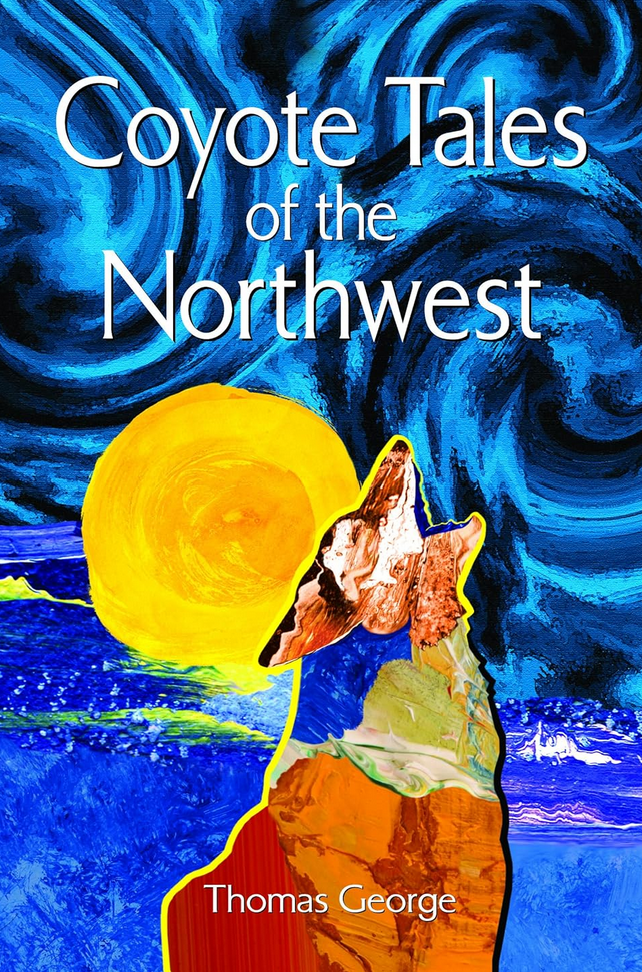
Coyotes are native to Oregon. They have been here since time immemorial. They are not going away. Coyotes are our neighbors whether we want them or not. They are an important part of our ecosystem. They bring the wild into our urban world, whether we want it or not. Love them or hate them, coyotes are here to stay. They are a part of the wild that will not be conquered.
Gayle Highpine is of Ktunaxa descent and the author of How To Make Friends With Wild Birds (Kinnikinnick Press).
 birdfriender.net
Leave a comment