Hawks need to eat too, but if you don’t want your feeder area to become a hawk buffet, you can encourage them to hunt somewhere else
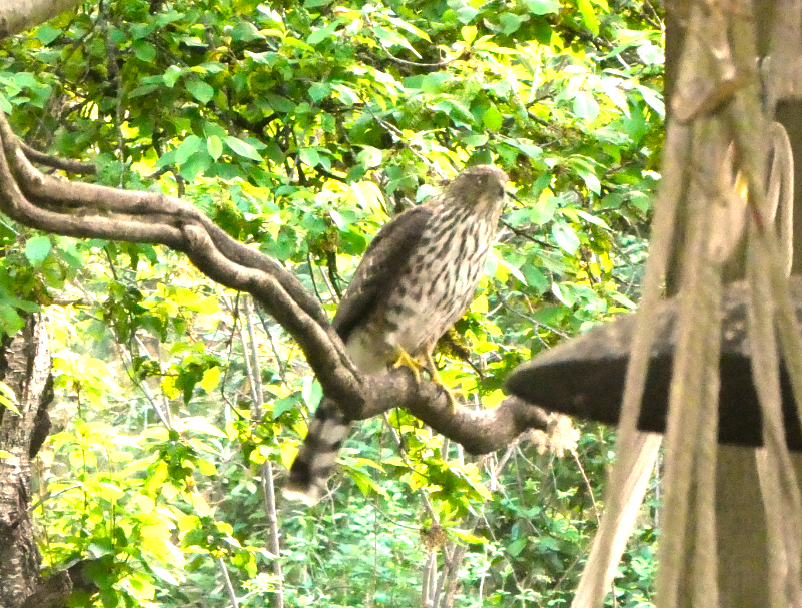
The easiest way to recognize an accipiter is by its long narrow tail. This Cooper’s Hawk is a juvenile, as shown by its dark, streaky breast plumage. (Photo by author)
So one day you look out into the back yard, and see a hawk perched there.
Wow! What a thrill, a raptor close up, right in the yard!
But no other birds are in sight. All the feeder birds have disappeared! Not a single songbird anywhere! Has the hawk eaten them all? Are they just hiding? Will they ever come back?
Or maybe one day you spot a pile of breast feathers on the ground. What happened here? Did a bird get eaten? And who ate it? A four-footed predator, or a hawk?
If there had been mangled remains – a mess of feathers, broken bones, feet – a four-footed predator may have eaten a bird at that spot. If there had been several flight feathers, maybe with other long feathers, lying there, a four-footed predator may have yanked them out to make the body easier to drag through the bushes. But a pile of breast feathers, perhaps mixed with a few feathers that are small but bigger than breast feathers, is the signature of a hawk kill. This is because a hawk catches a bird, it brings its prey up to a nearby perch and pulls out the breast feathers, to eat out the internal organs first. Then when the body is light enough, the hawk flies away with it.
So one of the birds in the yard has been eaten by a hawk!
But first, let’s clarify the word “hawk.” We, in North America, use the name “hawk” for several different groups of raptors, and this can cause us to think that all “hawks” are threats to songbirds. But hawks of the buteo group, such as the Red-tailed Hawk, hunt ground prey like rodents and quail. They can’t hunt prey that flies away, and don’t even try.
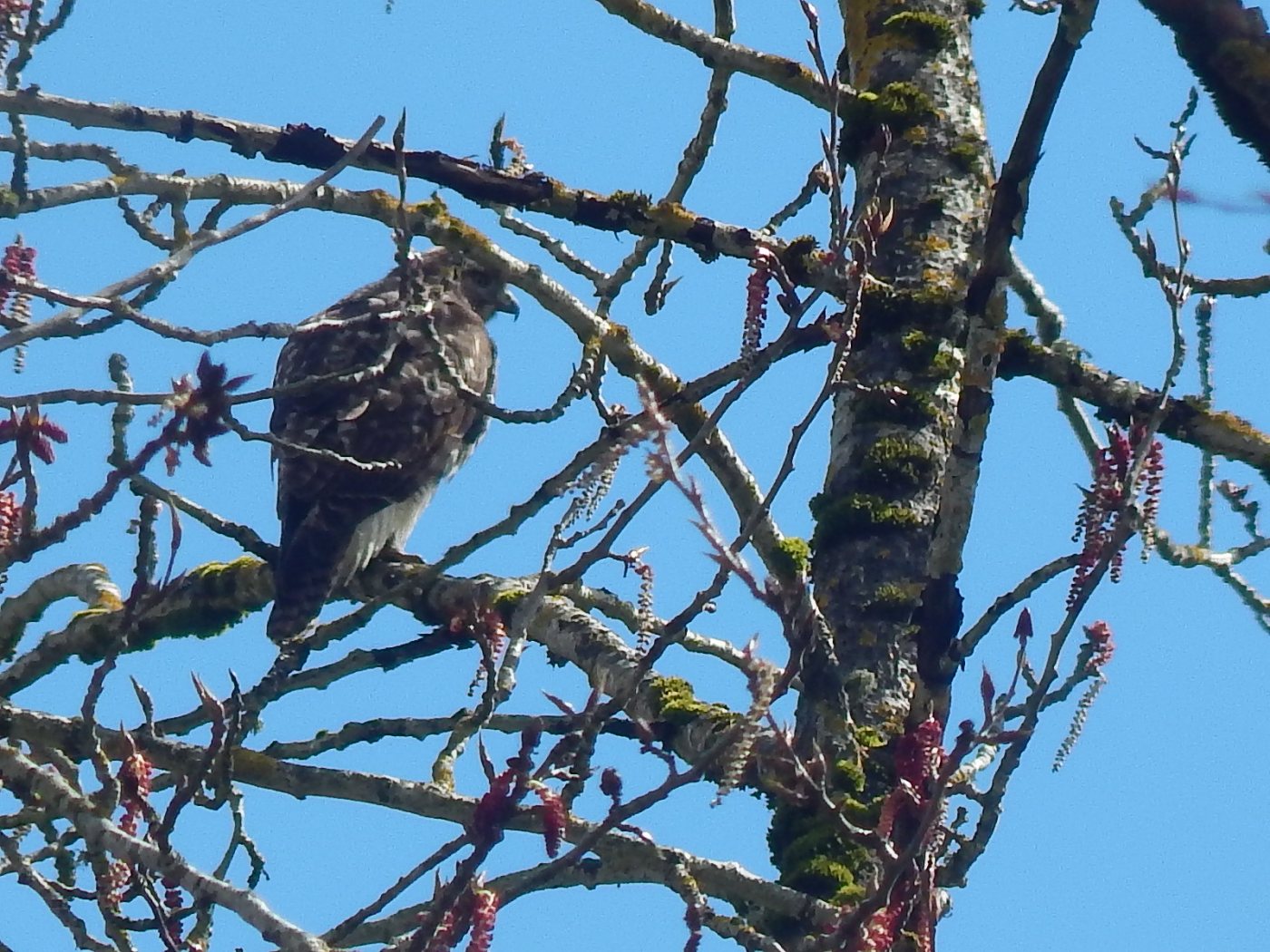
A buteo, such as this Red-tailed Hawk, has a distinctly different shape from an accipiter. When perched, it looks more “shouldery,” and its tail looks rather stubby. (Photo by author)
The hawks who prey on backyard birds are members of a group of raptors called accipiters. There are three species of accipiters in North America. From small to large, they are the Sharp-shinned Hawk (aka “Sharpie”), the Cooper’s Hawk, and the rare Northern Goshawk (“goose hawk”), who lives only in remote boreal forests. Although, once in a while, a Redtail fledgling exploring the world may wind up in someone’s back yard, it’s not interested in the feeder birds. The hawk in your yard is almost always an accipiter — a Cooper or a Sharpie.
The easiest, most definitive way to recognize an accipiter is by the length of the tail. Accipiters have longer tails than any other raptors, striped with dark bars. The tail makes the slender body appear even longer. Coopers and Sharpies look very similar; they are told apart mainly by size (and within each species, females are larger than males). Cooper’s Hawks range from the size of a flicker to the size of a smaller crow. Sharpies range from about the size of a Blue Jay to the size of a Common Grackle. Being of different sizes, they hunt different sized prey; Coopers hunt birds the size of doves, robins, and flickers, and squirrels as well. Sharpies prey on small birds like chickadees and sparrows, though they have been known to tackle birds as large as themselves.
The hawk is beautiful and striking, but it is the only bird in sight; all the feeder birds have vanished. How can you protect your feeder birds from the hawk. Should you even try? On social media, if you ask how to keep hawks from hunting at your feeders, some people may berate you. After all, hawks need to eat too!
Yes, hawks need to eat too, but they aren’t going to starve if they can’t eat at your feeders. It’s your yard, your feeders, and your choice whether or not to make it possible for them to hunt at your feeders; you might decide you’d rather watch hawks than songbirds. But if that is your choice, the problem is that, if the hawk becomes a regular visitor, the songbirds won’t just hide; they will stop coming to your yard at all. Then, without prey to hunt, the hawk will stop coming too. So soon there will be no birds to watch in your yard.
So how do you make your feeder area safe from hawks? By making your yard a place where – no matter how many birds are there – it is impossible for an accipiter to hunt them. When you saw the hawk in your yard, he wasn’t hunting at that moment. He was scoping things out, looking for hiding places and ambush spots, mapping out possible escape routes. He was deciding whether this might be a good hunting ground for him. If it is, he’ll keep coming back – though you won’t see him while he’s hunting, you’ll only find breast feathers on the ground.
The key to making a yard hawk-safe is to arrange the landscaping to make it impossible for accipiters to hunt birds. To do that, we need to understand how they hunt.
Minimizing hawk hiding places
It’s not easy to hunt prey that can fly away. An accipiter can’t hunt birds the way a Peregrine Falcon does; the Peregrine flies faster than any other bird and can knock a bird out of the sky. An accipiter doesn’t fly as fast as the birds it hunts, they also have much faster reflexes and quicker takeoff. And – unlike the rodents hunted by the Red-tiled Hawk, which have poor eyesight and can’t see the hawk coming — birds have extremely good eyesight and can see danger far away. So how does a Cooper or a Sharpie hunt its feathered prey?
It hunts by hiding. By waiting. Until the right moment. Thick foliage is unusually the best hiding place.
The hawk gets the most perfect chance is when its prey comes right below where it is hiding. Whether the songbird is below it on a perch or below it on the ground, the hawk drops and it is over,
So check your yard for potential accipiter hiding places. Imagine you are an accipiter checking out the yard and looking for all the different places you could hide.
The first thing you look for. Is there any hiding place above the feeders, from which a hawk could just drop on a bird?
Some people have witnessed hawks coming to the feeders from below, as well. They can do this if there are hiding places there. So check the ground for potential hiding places. If hiding places cannot be eliminated, barriers like tomato cages can help.
And, even more important! Look above and around the birdbath for foliage where a hawk could hide. A wet bird is briefly unable to fly. Even if it sees the hawk, for a crucial few seconds, it can’t get away. It’s a sitting duck, so to speak.
If there is no foliage above the feeders and birdbath, that makes things a little harder, but the hawk will not give up. There may be foliage farther from the feeders where the hawk could hide, even though it would have to fly in a horizontal path to catch a bird at the feeders. If it takes more than a second or two for the hawk to cross the space between the hiding place and the feeders, the small birds are out of there.
So if the feeders and birdbath are too far from potential hiding places, the hawk won’t be able to hunt there.
Maximizing songbirds’ chances of escape
Eliminating potential hiding places around your yard could be enough to discourage accipiters from hunting at your feeders. But it’s possible they may still try. So the second part of protecting feeder birds from hawks is to optimize the feeder birds’ chances to escape.
One way to do this is to provide hiding places for the feeder birds. The birds have an alarm for hawks that they all understand – a high quick “zeet” sound, given only once, by whoever sees the hawk. The birds immediately go silent (so as not to give away their locations) and go into hiding. Even birds who don’t hear the alarm know the meaning of the sudden silence and go into hiding too.
But they need places to hide. For small birds like chickadees, sparrows, juncos, and so on, dense woody bushes, too dense for a hawk to fit, are perfect. But larger birds like robins and flickers need hiding places too, so shrubs for them.
But hiding places aren’t the only thing the birds need. Because sometimes the hawk will surprise a bird before it has had the chance to hide. The only thing the bird can do is to take off and fly away. Then the hawk has to pursue its prey through the air.
But smaller birds fly faster than hawks. With less than a second’s head start, the songbird will certainly escape the hawk.
Unless the songbird meets obstacles in the way – trees, bushes, power poles. The songbird has to slow down to dodge them, but the hawk doesn’t slow down a bit. The hawk has the obstacles memorized. I saw videos where a tiny camera, affixed to a Cooper’s Hawk, caught the hawk’s pursuit of a songbird through the woods. While the panicked songbird had to slow down to avoid branches and trees, the Cooper’s Hawk was didn’t slacken its speed at all. Birds have extraordinary ability to memorize what they see — consider how migratory birds remember their routes and caching birds remember their cache locations — and the accipiter uses that ability to remember every tree, branch and shrub in the woods.
This is why an accipiter has such a long tail. Birds use their tails to steer and maneuver in flight. The the Redtail spreads its tail like a fan and adjusts it to to surf the thermals The Cooper’s Hawk’s tail makes it supremely maneuverable as it zigs and zags through the air at top speed.
So the best habitat for a Cooper’s Hawk is a densely wooded area, full of both plenty of hiding places for the hawk and obstacles that will slow down a songbird’s escape. This is why accipiters are sometimes called “woodland hawks.”
So should the hawk give up if the area around the feeders is completely open in all direction, clear of all foliage, trees, bushes, and other obstacles? Not necessarily. Although songbirds can fly faster than hawks, they can’t keep it up very long. Smaller birds have to flap more, and flapping costs a lot of energy, especially flapping at top speed. And a small bird lives at the edge of its energy reserves. So if the chase is long enough, the small bird can quickly get exhausted, and the hawk can still get it.
But if the songbird has a place to flee where the hawk can’t follow, it can escape.
In some yards, it is impossible to eliminate hiding places near the feeders (maybe there are big old trees too close) so some people who live in such yards concentrate on creating barriers with sections of cattle wire fencing, which almost all songbirds can fly through. even at top speed, but a hawk can’t. In some yards it may be possible to put wire barriers between the potential hawk hiding places and the feeders.
So, checking out the yard, the hawk discovers:
1) no hiding places above feeders or birdbath
2) the hiding places around the feeders are so far that it would take a couple of seconds to reach the feeders, giving the songbirds a head start to escape
3) open space with no obstacles in one direction, where a songbird could fly without slowing down
4) but the open space doesn’t go so far that the songbird would run out of energy
5) and there are places the songbird can pass that the hawk can’t follow.
It doesn’t matter how many songbirds (and doves and woodpeckers) come to the feeders — if the hawk sees that it will be impossible to catch them, it won’t hunt there. The hawk may still hunt in the vicinity sometimes — a Cooper’s Hawk pair has a territory of roughly a square mile, and hunts throughout the territory. But if you can make your feeder area safe from hawks and other predators, the songbirds will associate you with safety and friendship. They will bring their fledglings to the feeders and feed them there right in front of you. And they will come to your yard not only to eat, but to relax in a safe place with their human friends.
Gayle Highpine is the author of How To Make Friends With Wild Birds (Kinnikinnick Press).
 birdfriender.net
Leave a comment